

Lease Types and Occupancy Costs
When evaluating commercial spaces to lease, we think it is important for all parties to understand the total costs to lease the space and make informed decisions. Real estate professionals can provide comprehensive analyses that compare base rent, expense reimbursements, lease concessions, tenant improvement costs, and other property specific expenses such as private parking costs. In this article, we will define the most widely used lease types and compare how expenses are treated differently.
If there is any conflict in how the industry term is defined below versus in the lease document, the terms in the lease always prevail. If you ever have questions about any terms of the lease, always ask before signing the lease document.
It all comes down to occupancy costs
Lease Types Explained
Not all leases are equal, but operating costs when comparing the different lease types can be very similar. The first table to the right (fig. 1.1) shows different types of leases; NNN, Industrial Gross, Modified Gross, Full Service. The property owner or their agent will quote a Base Rent amount and the operating expenses a tenant pays will be based on the type of lease stated above. The second table below (fig 1.2) gives a mathematical example of how, with the different lease types, the costs add up to the same overall cost.
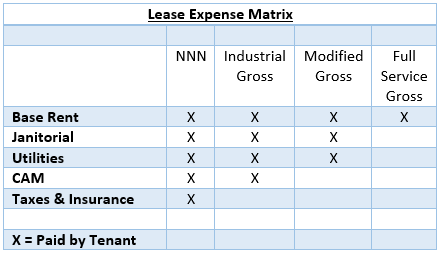
Figure 1.1
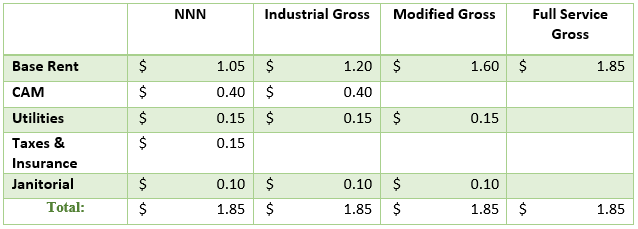
Figure 1.2
Industrial Gross Error:
Many agents quote Industrial Gross as net of Janitorial and Electricity/Gas, but rent could also exclude HVAC maintenance, water, and garbage.
Be sure to ask.
So what goes into operating costs?
Base Rent—This is the rent a tenant pays and is stated in the lease. Real estate agents will quote this rent. Often we create a schedule or table to reference in the lease proposal and lease document to eliminate discrepancies or misunderstandings during the lease term.
Base Year—The Base Year is the initial year of the lease and is used for Gross Leases to assist in calculating operating expenses. If the lease is executed and the tenant moves in to the property in 2016, then the base year would be 2016. The operating expenses in a Base Year is paid for by the Landlord and calculated in the Base Rent
The landlord calculates the operating expenses for each subsequent year of the lease (“Comparison Year”) and compares the operating expenses paid Base Year. See the table below
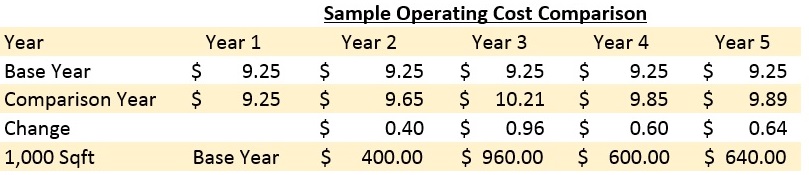
Figure 1.3
In an office lease, the tenant is responsible to pay for the difference in operating expenses from the Base Year and the Comparison Year. This amount the tenant pays is often referred to as “operating expense pass throughs” because the cost of the increase in operating expenses is “passed through” and paid for by the tenant.
Pro Rata Share—this is the percentage of rented space to the total property square footage (fig 1.4). Pro rata shares are important for tenants and landlords to portion costs as a percentage of occupancy. Leases will state the total project square footage and the pro rata share as a percentage of the total.

Figure 1.4